
Media
How accurate is Cantonese sentiment analysis? How UNDARIS validates social listening
How accurate is Cantonese sentiment analysis in Hong Kong? See how UNDARIS validates tone, irony, parent posts, and context before reporting a business signal.
“How accurate is Cantonese sentiment analysis?”
On the surface, this sounds like a question about model accuracy. In practice, it is a more useful question: when a team sees a set of comments from Hong Kong audiences, is the conclusion strong enough to change the next decision?
If every sentence is reduced to positive, negative, or neutral, the answer is often incomplete. Hong Kong audiences use Cantonese, English code-mixing, emoji, irony, exaggeration, wordplay, and platform-specific tone. The same phrase can mean something very different under another parent post or on another platform.
UNDARIS does not treat “understanding Chinese” as the answer. Its job is to preserve how people in Hong Kong actually speak, interpret what they mean in context, and show whether that signal should change what a business does next.
If you want the broader explanation first, read What is social listening? How UNDARIS reads Hong Kong online context. This article focuses on one narrower question: how to validate Cantonese sentiment analysis.
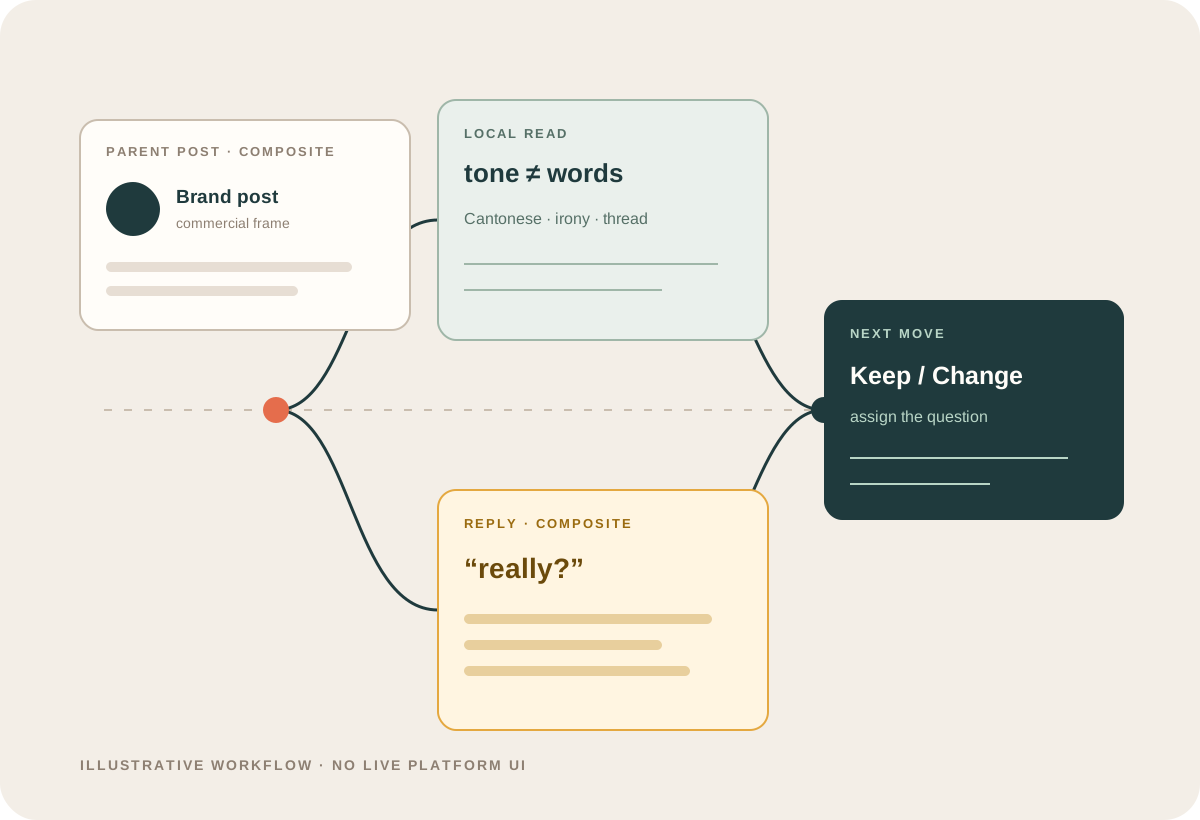
Accuracy is not a single percentage
An accuracy percentage without a sample, platforms, time range, label definition, denominator, and review method is difficult to connect to a real business decision.
For example, a system may easily separate an obvious “tasty” from an obvious “not tasty.” Literal wording is less useful when the task is to determine:
- whether a compliment is genuine or sarcastic;
- whether someone is discussing the product, price, advertisement, KOL, service, or another user;
- whether a short reply stands alone or depends on the offer, product, or activity in the parent post;
- whether “out of stock” is a neutral availability fact or has already caused a wasted trip;
- whether a positive product comment still contains a complaint about price, packaging, or the purchase channel.
The real validation question is therefore not only whether the sentiment label is right. It is whether the evidence chain is reasonable, traceable, and reviewable.
Read tone before literal words
Hong Kong Cantonese cannot be understood by converting each word into English or formal written Chinese. Sentence-ending particles, rhythm, code-mixing, emoji, and surrounding conversation can change the position a comment expresses.
Consider these examples:
我都想試下is light trial interest, not a confirmed purchase decision;試下先suggests a wait-and-see position rather than clear approval;真係好抵呀under an offer post may mainly signal price-value approval, not broad brand preference;有優惠好吸引says the offer is attractive, while leaving availability, redemption, and information gaps open;請問兩款可同時服用嗎?is a neutral usage question that may reveal missing FAQ content or conversion friction.
If all five are reduced to positive, neutral, positive, positive, and neutral, a team still does not know whether to change the offer, add information, improve product guidance, or take no action.
The parent post changes the meaning of a comment
The parent post is the original post a comment responds to. It is not an optional link. It is often the main context needed to interpret a short reply.
快啲去啦 is ambiguous on its own. Under a clear offer, product, or redemption post, it may be a recommendation, a prompt to purchase, or an invitation to participate.
Availability language also needs context:
冇貨may be a neutral stock fact or a question;買唔到may already describe a purchase barrier;白行describes time cost and service disappointment;換咗三張券都用唔到points to operational, trust, or redemption friction.
If a positive parent post receives 誤導, 伏, 唔好食, or another direct negative response, the direct response should not be overwritten by the positive atmosphere of the original post. A positive parent post does not make every reply positive.
色素😂 should not be dismissed as a joke because it contains an emoji. Under a post about a brightly coloured food, it may signal sarcasm, a product-quality concern, or a safety association. It should remain a high-risk case until the context is reviewed.
Hong Kong Cantonese is not just Traditional Chinese
Hong Kong online language includes written Cantonese, English code-mixing, forum slang, irony, and platform-specific ways of speaking. Formal Chinese, Mandarin usage, or another region’s internet vocabulary cannot be treated as a direct substitute for this context.
Examples include:
真係好有誠意喎may be sarcastic in a discussion about a price increase, smaller portions, or a promise that was not kept;cool 牙先喇!contains the English word “cool” but may be Hong Kong-style phonetic mockery rather than praise;個campaign唔workusually says that the message or creative did not persuade people, not that the website code has failed;太hard sellcan criticise the communication tone, sales pressure, or fit with the brand;PR到出面may raise an authenticity concern, depending on the platform and the surrounding discussion;笑死can describe genuine laughter, embarrassment, sarcasm, or helplessness;父親節請老豆食KFC😂?真孝順may mock the campaign or brand choice rather than offer a sincere Father’s Day blessing.
Particles such as 喎, 囉, 添, 先, and 㗎 are not meaningless filler. They can signal surprise, doubt, resignation, a complaint at the edge of being explicit, or hesitation. Platform norms matter too. LIHKG and Threads can contain more irony, dark humour, or indirect attacks; Instagram replies may be shorter and more dependent on emoji or English; Facebook replies are often more direct and conversational. These are reading cues, not automatic labels.
How does UNDARIS validate a conclusion?
UNDARIS does not begin by asking whether a sentence is positive or negative. It preserves the conversation first, then narrows the question layer by layer:
preserve the original wording
→ verify the parent post
→ set the product, activity, and commercial context
→ read tone, platform, and discussion target
→ contextual sentiment + discussion target + issue lens
→ native review for high-risk cases
→ lock rows after validation
→ aggregate with code
→ route the business next move
The first step is to keep the original wording rather than rewriting Cantonese into formal Chinese. The team then confirms that the parent post exists, identifies what the comment is responding to, and records whether the commercial frame concerns product experience, an offer, redemption, stock, service, or another issue.
Once the context map is established, each valid consumer comment can have a structured record containing:
- the original wording, platform, time, and comment ID;
- the related parent post ID;
- the surface meaning and possible intended meaning;
- contextual sentiment;
- the discussion target, such as product, price, content, KOL, service, or brand;
- the issue lens, such as product truth, purchase barrier, trust, or creative reaction;
- whether the reply changes the reading of the parent post or depends on it for meaning;
- confidence, review status, and whether it can be used in aggregation.
Search-result snippets do not replace this evidence. They can help discover a possible URL. The actual analysis must return to the platform post, parent post, and comment context.
Uncertainty should become review, not a forced label
Some cases require human confirmation. That is not a process failure. It is an honest response to complex local language.
Cases that should enter native review or temporary quarantine include:
- positive wording paired with a negative fact, such as
真係好有誠意喎after a price increase; - wordplay, irony, or platform-specific slang such as
cool 牙先喇!; - product safety, colour additives, food quality, or bodily-use concerns;
- authenticity concerns such as
PR到出面,打手, or帶風向; - competitor switching, purchase abandonment, repeated stock-outs, or failed redemption;
- a comment that praises the product while criticising the price or service.
Swearing is not automatically negative, and a positive adjective is not automatically support. Official brand replies, spam, irrelevant tags, or clear noise should keep an exclusion reason rather than disappearing without explanation.
Six signal pillars turn sentiment into business questions
Sentiment labels are one layer of organisation. UNDARIS uses six lenses to help a team ask a question closer to the decision.
Audience Tension
Who feels overlooked, excluded, or no longer addressed by the brand? This lens helps separate an isolated complaint from a wider tension around identity, expectation, or cultural relevance.
Purchase Barrier
What turns interest into hesitation, abandonment, or a switch to another choice? A comment may say that someone wants to try a product while follow-up questions about price, location, stock, redemption, or usage reveal that the purchase threshold has not been cleared.
Product Truth
What is the real usage experience, and why do people continue, reduce use, or leave? This pillar breaks a broad statement about whether a product is good into more useful questions about taste, quality, results, use cases, repeat purchase, and alternatives.
Creative Reaction
How do people respond to the content, creative idea, or KOL? If the available data mostly concerns the product or service, the report should show a coverage gap instead of treating every interaction as proof that the creative worked.
Trust & Authenticity
Which promise is being challenged by lived experience, or which piece of content feels over-packaged? Phrases such as PR到出面, 打手, or 誤導 do not automatically mean the whole brand has failed, but they do require the original post, platform, and target of the discussion to be checked together.
Momentum & Risk
Which UGC, share, save, stock-out, or repeated complaint appears to be gaining force and deserves attention first? One occurrence is not enough to announce a crisis. The useful question is whether the signal persists, where it is concentrated, and whether it can change the next decision.
One comment may touch several pillars. They are not six scores that can be added together. For example:
真係好抵呀may show price-value approval without proving brand loyalty;請問兩款可同時服用嗎?may show product interest while revealing an information gap;個campaign唔workmay be a creative reaction without rejecting the product;下次去7仔都係買麵包may point to product experience and an alternative choice, not just a generic negative sentiment;- a service complaint may challenge fulfilment or trust without proving that the product has no value.
Conclusions begin with validated rows
A useful conclusion should answer four questions:
- What: what was actually observed?
- Why: why does it mean this in the Hong Kong context?
- So what: what does it imply for the product, content, service, brand, or risk?
- Next move: should the team Keep, Change, Test, or Watch?
UNDARIS does not process every comment in one prompt and immediately ask a model to write headline counts. Comments are processed in batches. Fields, IDs, row counts, and enums go through validation; failed or unstable batches are retried or quarantined; high-risk cases enter native review.
Counts are generated in code from rows that have passed validation and been locked, with different scopes kept separate. A report should show its denominator, data range, platforms, time period, limitations, and coverage gaps. That is where technical trust comes from, not from saying that a team “uses AI.”
How AI Concept Studio uses the insight
UNDARIS is the intelligence layer of AI Concept Studio, but the two names should not be treated as the same product.
UNDARIS first turns public Hong Kong conversations into an evidence-backed insight. AI Concept Studio then takes the confirmed signal and connects it to the business question through strategy, content, creative, website, or automation work. The order matters: understand what people are actually saying before deciding what to change, instead of producing a set of assets and searching for a justification afterwards.
Social listening can reveal a purchase barrier, trust issue, or creative reaction. It cannot, by itself, prove that sales, ROAS, or campaign performance has improved. The claim should match the evidence. Where evidence is missing, the point remains a hypothesis to test.
Start with a bounded question
If a team only knows that it wants to understand what people think, it can start with a bounded Free Signal Read: up to 10 relevant parent posts, 100 relevant comments, a 1–3 page signal memo, 3–5 signals, and one next step.
A smaller scope does not make the answer shallow. It creates a concrete demonstration of how a parent post and a reply are interpreted through Hong Kong context and turned into a decision the team can discuss.
Frequently asked questions about Cantonese sentiment analysis
Can Cantonese sentiment analysis be 100% accurate?
That should not be promised. Without a sample, platforms, time range, label definition, review method, and denominator, an accuracy percentage is difficult to connect to decision value. UNDARIS separates rows that can be classified from cases that need review or temporary quarantine, so the evidence behind a conclusion remains visible.
How is UNDARIS different from general Chinese sentiment analysis?
The difference is not converting Traditional Chinese into another form of Chinese. UNDARIS verifies the parent post first, then reads Hong Kong Cantonese tone, irony, code-mixing, emoji, platform, and discussion target. It does not stop at positive or negative labels; it organises contextual sentiment, issue lenses, and a business question the team can act on.
How do you validate a social listening result?
Start with the original wording. Confirm the parent post, set the product or activity context, record the parent ID, comment ID, platform, and scope, then send high-risk cases to native review. Only validated and locked rows are aggregated with code, with limitations and coverage gaps shown in the report.
Does UNDARIS represent every Hong Kong audience?
No. Public conversation is not a complete census of every person’s opinion, and platforms have different roles and data limitations. UNDARIS defines scope from the decision question and states what was and was not covered. A Free Signal Read is deliberately bounded to up to 10 relevant parent posts, 100 comments, a 1–3 page memo, 3–5 signals, and one next step.
The first-principles answer
The value of Cantonese sentiment analysis is not the speed of assigning a positive or negative label to every Hong Kong comment. It is the clarity a team gains about what people mean, which context supports that reading, what the evidence cannot prove, and who should own the next move.
For Hong Kong audiences, language is more than literal translation and context is not an optional add-on. A team needs to understand how people express approval, disappointment, irony, hesitation, and the intent to leave before it can choose the right next step.
See how UNDARIS works. If you have a question about a brand, product, launch, or issue, WhatsApp us to request a Free Signal Read; if email is more convenient, email cs@aiconceptstudio.online.
EVIDENCE LINKS
Sources and further reading
When an article uses current events or external information, the actual sources are listed here.
This article is based on confirmed ACS methods and service information and does not rely on external current-affairs sources.