
Media
Social Listening Tools in Hong Kong: Brandwatch, Meltwater, Talkwalker, Native Analytics or AI?
Compare Brandwatch, Meltwater, Lumen, Meta analytics, AI workflows and UNDARIS for Hong Kong coverage, Cantonese context, workflow and total cost.
Brandwatch, Meltwater and Talkwalker all offer powerful feature sets. But the tool with the most features is not automatically the best fit.
For Hong Kong brands, the more useful comparison is coverage, Cantonese and local context, workflow, depth of analysis, and whether the output actually helps your team make a decision.
Start searching for social listening tools in Hong Kong and the same names appear quickly: Brandwatch, Meltwater and Talkwalker.
Keep going and you will also find social media monitoring tools, native analytics, AI sentiment analysis, and teams using ChatGPT or other LLMs to analyse comments directly.
The more options you find, the harder the real question becomes:
Which one should a Hong Kong brand actually choose?
If you are still deciding what social listening means in a Hong Kong context, read our earlier guide first: What is social listening? How UNDARIS reads Hong Kong online context.
This article does not repeat the definition.
It focuses on the buying decision.
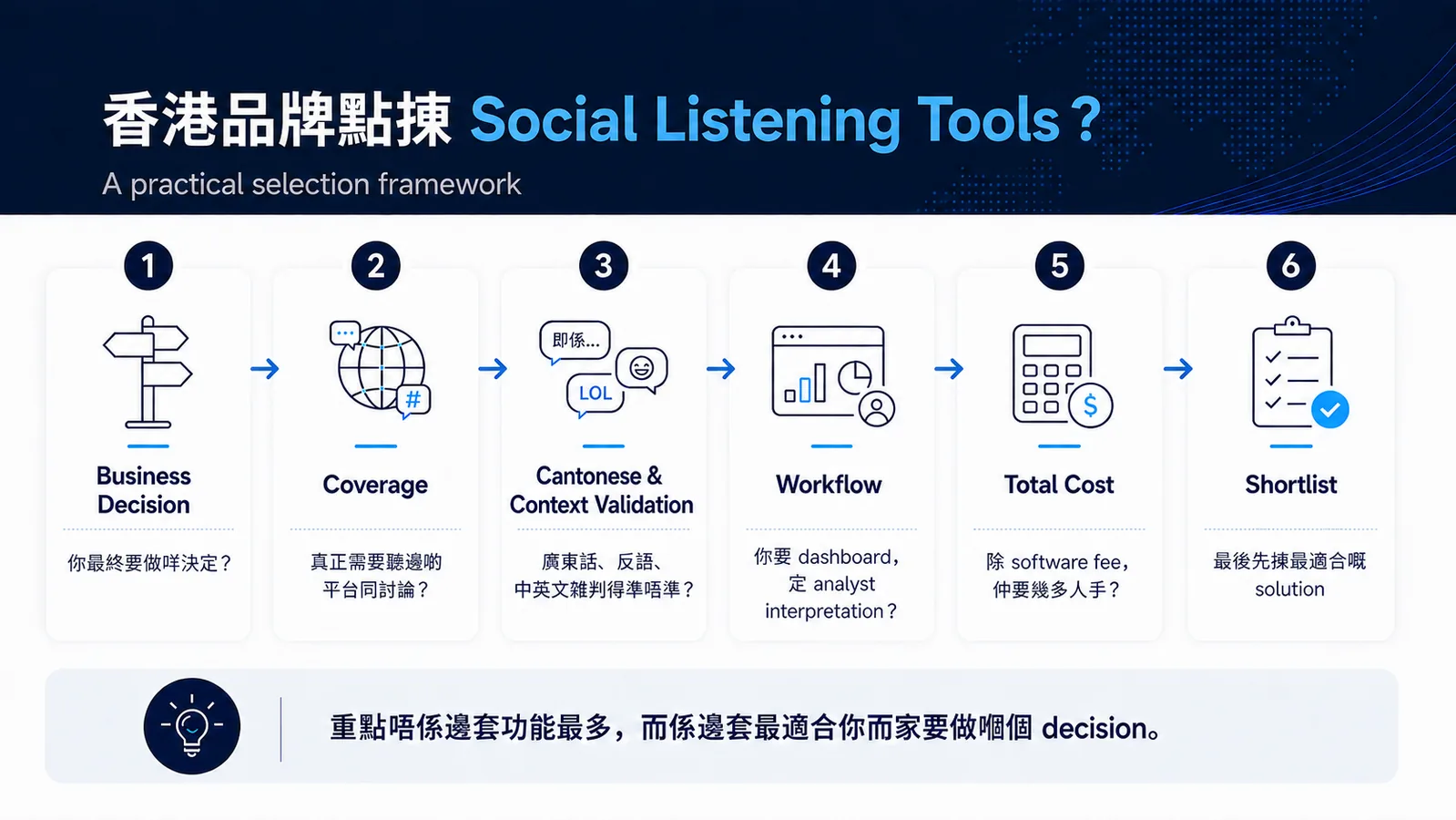
The short answer: choose by use case, not by ranking
This is not a “best tools” ranking. It is a practical shortlist based on what you actually need to do.
| Your main need | Start by considering | Why | What to validate |
|---|---|---|---|
| Global / regional always-on social listening | Brandwatch / Lumen by Talkwalker / Meltwater | Broad data coverage, monitoring, dashboards and enterprise workflows | Hong Kong coverage, Cantonese classification and analyst workflow |
| PR + news + social in one workflow | Meltwater | Media intelligence is a core part of the wider platform | Whether the depth of social analysis matches the marketing team’s needs |
| Large-scale consumer intelligence | Brandwatch | Large-scale public conversation research and historical data | Local queries, taxonomy and Cantonese context |
| Owned Facebook / Instagram / Threads performance | Meta native analytics | Direct first-party account performance data | It does not replace cross-platform category or competitor listening |
| Custom classification / theme analysis | AI / LLM workflow | Flexible taxonomy, summarisation and theme extraction | Data collection, QA, benchmarking and source traceability |
| A bounded Hong Kong campaign or consumer question requiring context | UNDARIS | Decision-first analysis with a Hong Kong context focus | It is not a global 24/7 enterprise monitoring infrastructure |
The point is not which platform has the longest feature list.
The point is:
Which setup best fits the decision you need to make now?
Brandwatch positions Consumer Intelligence around large-scale consumer research, with broad access to social, news, review, forum and other public sources. Brandwatch also supports Threads data.
Sources: Brandwatch Consumer Intelligence / Brandwatch Threads
Meltwater combines social listening with a broader media intelligence workflow, covering social networks, news and other media sources across multiple countries and languages.
Sources: Meltwater Social Listening / Meltwater Social Media Monitoring
Talkwalker has been rebranded as Lumen by Talkwalker, retaining social listening, media monitoring, competitive intelligence and visual listening capabilities.
Source: Lumen by Talkwalker
All three are powerful.
But powerful and right for you are not the same thing.
Before choosing a social listening tool, answer five questions
1. Decision: do you need to monitor, or do you need to decide?
Some teams genuinely need this:
“Negative mentions are rising. I need an alert immediately.”
That is a monitoring problem.
A different team may be asking:
“Negative comments are rising. Is the real cause pricing, product quality, delivery, or a gap between the campaign promise and the actual experience?”
That is an interpretation problem.
Both can sit under social listening, but the required workflow is very different.
If you manage regional corporate reputation across dozens of markets, a 24/7 enterprise platform makes sense.
If you have just finished a Hong Kong campaign with 3,000 comments and the real question is:
“Did people actually buy into the idea?”
you may not need another dashboard.
You may need a workflow that moves from:
Discussion → Theme → Evidence → Interpretation → Decision
So the first question should always be:
What decision are we trying to make?
2. Coverage: where do you actually need to listen?
Social listening software often leads with coverage.
Millions of sources. Hundreds of markets. Hundreds of languages.
Bigger numbers feel reassuring.
But there are two different kinds of coverage.
The first is:
How many data sources can the platform access in theory?
The second is:
How much relevant conversation can it actually capture for your business question?
Those are not the same thing.
For a Hong Kong consumer campaign, Facebook comments, Instagram replies, Threads discussions and YouTube comments may each represent different behaviours.
For a regional PR issue, the critical mix may be news, broadcast, forums and social together.
So instead of asking:
“How many sources do you have?”
ask:
“Can you capture the Hong Kong conversations that matter to this decision?”
Breadth is a genuine advantage of enterprise platforms.
But an additional source only creates additional value when it has a reasonable chance of changing the decision.
3. Cantonese & context: do not stop at “supports Chinese”
Hong Kong social listening is sometimes simplified into one claim:
“Global tools cannot understand Cantonese.”
That is too broad.
Modern large language models can handle Cantonese to a meaningful degree.
A 2024 peer-reviewed Hong Kong study tested sentiment classification on 6,169 Cantonese online counselling messages. GPT-4 achieved 95.3% accuracy on that specific dataset, substantially outperforming a traditional lexicon-based approach.
But the same paper explicitly warned that counselling conversations differ from social media and customer feedback, so the result should not be generalised to every domain.
Source: Journal of Medical Internet Research — Efficacy of ChatGPT in Cantonese Sentiment Analysis
Cantonese NLP research also points to practical challenges including colloquial language, multilinguality, code-switching and relatively limited language resources.
Source: ACL Anthology — Cantonese Natural Language Processing in the Transformers Era
So the better question is not:
“Can the AI read Cantonese?”
It is:
“Has it been validated on the kind of Hong Kong language your audience actually uses?”
Consider comments such as:
“個 design ok,但呢個 price point 真係……”
“好呀,下次唔急先再幫襯。”
“又係咁,品牌嘢係尊貴啲嘅 🙂”
“咪就係囉 🙃”
Taken out of context, a classifier may not be completely wrong.
But without the original post, reply context, emoji, code-switching and surrounding conversation, it can still answer the wrong business question.
A more useful test is simple:
Take 50 to 100 real Hong Kong comments from your own brand or category. Include sarcasm, mixed Chinese-English language, mixed sentiment and reply context.
Then run a blind test.
Do not ask the sales deck:
“Do you support Cantonese?”
Ask:
“How do you classify this actual data?”
4. Workflow: do you need a dashboard, or interpretation?
Dashboards are useful.
You may see:
Negative Sentiment ↑ 18%
But the marketing team’s next question is normally:
“Why?”
Price?
Delivery?
Product performance?
Customer service?
Creative?
Or did one viral post distort the entire week?
The next question matters even more:
“What should we do?”
This is where many social listening workflows break.
A system can quickly tell you what happened.
But explaining why it happened, which issue deserves action, whether there is contradictory evidence, and whether the next move should be to Keep, Change, Test or Watch usually requires business interpretation.
When evaluating a platform or workflow, ask to see the full chain:
Raw Conversation → Theme → Evidence → Interpretation → Recommendation
Do not judge the solution by the final pie chart alone.
5. Total cost: software fees are only part of the cost
When comparing social listening platforms, the licence fee is the obvious number.
But the real cost can also include:
query setup, Boolean search, taxonomy design, dashboard configuration, false-positive cleanup, manual review, reporting, internal training and ongoing analyst time.
The better question is not:
“How much is the software per year?”
It is:
“How much resource does it take to move from a business question to enough evidence to make a decision?”
A large platform can be a very rational investment for a company with a Consumer Insights team, dedicated analysts and a regional operating model.
If a Hong Kong marketing team only needs a few deep campaign diagnostics each year, an always-on enterprise stack may not be the most efficient answer.
The issue is not cheap versus expensive.
It is utilisation.
Brandwatch: a strong fit for large-scale consumer intelligence
Brandwatch’s clearest advantage is scale.
Its Consumer Intelligence offering is built around broad consumer research, historical data, AI analysis, custom classifiers and large-scale data coverage.
That makes it a logical shortlist option for:
regional brands, global consumer insights teams, long-term competitor intelligence, trend monitoring and historical research.
Source: Brandwatch Consumer Intelligence
The question is not whether Brandwatch is good.
The question is:
Do you have enough use cases to use what you are paying for?
For a Hong Kong team, we would still test local queries, Cantonese classification and discussion context rather than assume that global scale automatically guarantees local interpretation quality.
Meltwater: when social and PR are part of the same problem
Meltwater is positioned somewhat differently.
It is not only a social listening platform.
Its wider product ecosystem combines online news, social, print, broadcast, podcasts and media monitoring.
Source: Meltwater Media Monitoring
That makes sense if your question looks like this:
“A corporate issue started in the news. How did it spread across Facebook, Threads and forums?”
For Corporate Communications, PR and regional reputation management, media and social intelligence often belong in the same workflow.
If the job is instead a deep analysis of one Hong Kong consumer campaign, the question changes:
Do you need the full media intelligence stack?
Lumen by Talkwalker: when you genuinely need always-on listening
Talkwalker has now been rebranded as Lumen by Talkwalker.
The platform continues to focus on large-scale social listening, media monitoring, competitive intelligence, visual listening, alerts and trend detection.
Source: Lumen by Talkwalker
These capabilities can fit:
large-scale reputation monitoring, competitive intelligence, multi-market consumer insight, crisis monitoring and long-term trend research.
Visual listening is also worth evaluating.
A brand can appear in an image or video without its name appearing in the text. Traditional keyword-only monitoring may miss that exposure.
If visual brand exposure matters to your KPI, it should be part of the shortlist criteria.
Meta native analytics: free, useful, and solving a different problem
Meta Business Suite, Instagram Insights and Threads Insights are absolutely useful.
If the questions are:
How much reach did our post get?
Which type of content drives engagement?
How are followers changing?
Which campaign post performed best?
native analytics may already be enough.
The limitation is that they mainly answer:
“What happened on our channels?”
Social listening usually expands the question to:
“What is the market saying outside our channels?”
Untagged discussion, competitor conversation and broader category chatter cannot be fully understood from owned-channel analytics alone.
Native analytics is therefore not a “basic version” of social listening.
It is a different data source.
Sources: Meta Business Suite Insights / Instagram Insights
Can you just use ChatGPT or an AI workflow?
Yes — for part of the job.
But separate two things:
Data Collection and Data Analysis.
LLMs can be very effective for:
classification, theme extraction, sentiment analysis, summarisation, coding, comparison and anomaly detection.
Research also shows that large language models can perform well in specific Cantonese analysis settings.
But being able to analyse text does not mean ChatGPT automatically has complete market data.
For a custom AI workflow, the harder questions are often:
Where did the data come from?
What is missing?
Are there duplicates?
Is there spam?
Can each comment be linked back to the original post?
Has the classification been benchmarked?
If the AI is wrong, who reviews it?
And most importantly:
Can every conclusion be traced back to evidence?
If not, you may simply be replacing one dashboard black box with an AI black box.
Threads can no longer be treated as “unavailable data”
When Threads first launched, social listening faced real data-access limitations.
That is no longer an accurate blanket statement.
Meta’s current Threads API includes capabilities such as Keyword Search, Insights and Reply Management.
Sources: Meta Threads API Reference / Threads Keyword Search
Brandwatch has also integrated Threads into Consumer Research, while Meltwater lists Threads among its supported social monitoring sources.
So the more useful question is no longer:
“Do you support Threads?”
It is:
What content can you search?
How much historical data is available?
How complete are replies?
Is the conversation chain preserved?
If someone replies “咪就係囉 🙃”, does the system know what they are replying to?
Can the final insight be traced back to the original post?
As data access improves, the next competitive layer becomes:
interpretation quality.
For a practical look at coverage, reply context and research methods, read our Threads social listening guide for Hong Kong brands.
A 30-minute shortlist test for your next vendor demo
If you already have demos booked with Brandwatch, Meltwater or another vendor, you do not need to review every feature.
Start with one real business question and use the same test for every vendor.
For example:
“Our Hong Kong campaign generated a large amount of discussion on Threads and Instagram last month. We want to know whether the main purchase barrier is pricing, product expectation or creative misunderstanding.”
Then test only five things:
- Decision — how far can the system actually answer the business question?
- Coverage — how much relevant Hong Kong conversation is captured?
- Cantonese & Context — how does it handle sarcasm, code-switching and reply context?
- Workflow — how much manual effort sits between raw data and recommendation?
- Total Cost — software + setup + analyst time.
Then do one more thing:
Ask to see the original source.
If an insight cannot be traced back to evidence, be careful — no matter how polished the dashboard looks.
Is UNDARIS better than Brandwatch or Meltwater?
That is not the right comparison.
If a company needs:
global 24/7 monitoring, dozens of markets, news + social + broadcast, enterprise user management and real-time crisis alerts,
a large enterprise platform is clearly the more appropriate infrastructure.
UNDARIS is not designed to replace that category.
It is better suited to a different type of question:
“Why are Hong Kong consumers not buying into this proposition?”
“We have 4,000 campaign comments. What is the recurring tension?”
“There is a lot of negative sentiment. Is the problem the product, or expectation management?”
“Competitor discussion on Threads suddenly increased. Is this a genuine preference shift, or just a short-term viral topic?”
For this type of work, the goal is not to collect the highest number of mentions.
It is to build an evidence chain:
Business Question → Relevant Public Signals → Hong Kong Context → Themes → Evidence → Decision
That is why UNDARIS is closer to a decision-led social listening study.
Not another dashboard.
The aim is to turn public Hong Kong conversation into a conclusion your team can challenge, verify and act on.
Learn more: AI Concept Studio — UNDARIS
Frequently asked questions
Is Brandwatch or Meltwater better for social listening in Hong Kong?
There is no universal answer.
If the priority is large-scale consumer intelligence, social research and extensive historical data, Brandwatch is worth shortlisting.
If PR, news, media monitoring and social listening need to sit in one workflow, Meltwater may be especially relevant.
In both cases, use your own Hong Kong data for a pilot rather than relying only on feature lists.
Can social listening tools understand Cantonese?
Modern AI and NLP systems can process Cantonese, and research has shown strong performance in specific Cantonese datasets.
But sarcasm, Chinese-English code-switching, emoji, brand slang and reply context still require domain-specific validation.
“Supports Chinese” should not be the only selection criterion.
Can you do social listening on Threads?
Yes, to a meaningful degree.
Meta’s Threads API now includes Keyword Search, Reply Management and Insights capabilities, while some major third-party social listening platforms have also integrated Threads data.
Actual coverage still depends on the tool, permissions, query design and research method.
Are free tools enough?
For owned-channel performance, native analytics can already be very useful.
If you need cross-platform consumer conversation, competitor intelligence, category trends or deeper qualitative interpretation, you will likely need an additional workflow or platform.
Can AI / LLMs replace a social listening platform?
Not always.
AI can be excellent at analysis, but it does not automatically provide complete data access, sampling methodology, QA, source traceability or continuous monitoring infrastructure.
In many cases, the most effective answer is a hybrid workflow: a platform handles data access, AI supports parts of the analysis, and an analyst validates the interpretation.
The final question is simpler than the tool list
Social listening gets distracting because there are so many tools.
Each one can give you more data.
More charts.
More AI.
More alerts.
But most businesses are not short of another number.
They are short of a decision supported by better evidence.
So before choosing a social listening solution, do not start with:
“Which tool is the best?”
Start with:
“Which business decision are we trying to make, and what consumer evidence are we missing?”
Once that is clear, it becomes much easier to decide whether you need Brandwatch, Meltwater, Lumen, native analytics, a custom AI workflow, or a focused Hong Kong social listening study.
You do not need to choose the tool first
If you already have a brand, campaign, launch or consumer issue you want to investigate, start with the question.
ACS can first help clarify whether the missing piece is data, coverage or interpretation.
If an enterprise platform is the better fit, not every problem needs to become an UNDARIS project.
But if the real problem is that Hong Kong consumers are saying a lot and your team still does not know what it means, why it matters or what to do next, that is where UNDARIS can be useful.
Start with the evidence. Then decide how much more you need.
EVIDENCE LINKS
Sources and further reading
When an article uses current events or external information, the actual sources are listed here.
- 01Brandwatch Consumer Intelligence
- 02Brandwatch Data and Network Coverage
- 03Brandwatch Threads Data
- 04Meltwater Social Listening
- 05Meltwater Social Media Monitoring
- 06Meltwater Media Monitoring
- 07Lumen by Talkwalker
- 08Meta Threads API Reference
- 09Meta Threads Keyword Search
- 10Meta Business Suite Insights
- 11Instagram Insights
- 12Journal of Medical Internet Research - Cantonese Sentiment Analysis
- 13ACL Anthology - Cantonese NLP in the Transformers Era