
Media
Threads Social Listening in Hong Kong: A Practical Guide to Brand Monitoring
Learn how Hong Kong brands can research Threads conversations, check coverage, interpret Cantonese replies and turn evidence into testable marketing decisions.
What can you research on Threads? How do you interpret a conversation and turn it into a useful next step for your brand?
Threads social listening is the practice of researching accessible public conversations around a brand, product or market question. It connects individual comments with their original posts, the people or issues they address, and the limits of the available evidence. It is more than searching for a brand name or labelling replies as positive, negative and neutral.
For Hong Kong marketing teams, the useful questions are more specific. Are people responding to the product, the offer, the purchase experience or simply the post itself? Does the same concern appear independently elsewhere? Is there enough evidence to change a message, investigate a service issue or keep observing?
More conversation does not necessarily mean more purchase intent. A complaint does not necessarily mean the price is the problem. This guide explains research scope, then works through two anonymised retail research examples and one clearly labelled fictional teaching example.
1. Can you use Threads for social listening?
Yes. Meta’s official Threads API examples include public Threads post search, and Brandwatch lists Threads data as available in Consumer Research. The useful evaluation question is therefore not simply whether a product supports Threads, but what it retrieves, what it misses and whether its findings can be checked.12
First, separate two different needs.
Measuring your own account concerns views, engagement, follower changes and content performance. Threads Insights includes metrics such as views, replies, reposts and quotes. A team that only wants to evaluate its own posts may not need a separate market research project.3
Researching brand or category conversations asks why people compare products, what stops an interested person from buying, and whether criticism concerns the product, the buying arrangements or a promotional promise.
The first tells you how your published content performs. The second asks what relevant conversations mean for a decision.
For a broader comparison of enterprise platforms, native analytics and research services, see our Hong Kong social listening tools guide. This article focuses on conducting a Threads study, rather than ranking tools again.
2. What can Threads brand monitoring capture—and what can it miss?
Finding a post is not the same as obtaining the complete conversation beneath it. Public search and access to replies need separate checks. Support for one capability is not evidence that a solution can retrieve every third-party post, historical reply or quote. Verify the actual results, permissions and gaps rather than treating “Threads API support” as a promise of complete coverage.1
Threads also offers follower-only replies and reply approvals. With approvals, authors can choose which replies appear publicly. Our research implication is that visible replies should not be described as the complete, unfiltered set of reactions people submitted.4
ACS recommends checking six areas before a study begins:
| Research check | What the study should disclose |
|---|---|
| Search scope | Brand names, product names, local nicknames, topics and exclusions. |
| Time window | Publication dates covered, collection dates and available historical depth. |
| Conversation completeness | Original posts, direct replies, nested replies and quotes obtained—and what is missing. |
| Hong Kong relevance | The inclusion criteria and how uncertain market relevance is handled. |
| Sample processing | Treatment of duplicates, brand-owned replies, promotional material and irrelevant comments. |
| Traceability | Whether findings can be checked against research records and where uncertainty remains. |
This is a research acceptance checklist, not a claim that every tool provides every field.
Language alone is not proof of location. Cantonese may help interpretation, but it does not establish that an author lives in Hong Kong. We recommend checking whether the conversation concerns Hong Kong stores, services or purchasing situations. When the evidence is insufficient, leave location unconfirmed.
3. Start with a marketing decision, not just a brand name
“Tell us what people think of the brand on Threads” is usually too broad. It can produce a large collection of material without clarifying what the team should do.
A more useful starting question is: Which decision should this study make less uncertain? For example, a team may be considering a bigger discount without knowing whether participation is limited by price, eligibility conditions or unclear information.
Structure the search around three layers:
| Research layer | Search directions | What you are trying to understand |
|---|---|---|
| Brand and product | English and Chinese names, common nicknames, products and campaign names. | What exactly are people responding to? |
| Category and alternatives | Comparable products, recommendations, comparisons and switching reasons. | Which criteria influence a choice? |
| Use and participation | Availability, eligibility, store arrangements, price and questions. | Where might an interested person encounter friction? |
These are research design examples, not validated high-volume search terms.
Do not follow only the most popular thread. Check whether several discussions repeat the same source, whether the same person is describing one incident repeatedly, and whether there are independent experiences or counterexamples.
For our research, repetition can help describe circulation. It does not automatically create an equivalent number of independent consumer experiences.
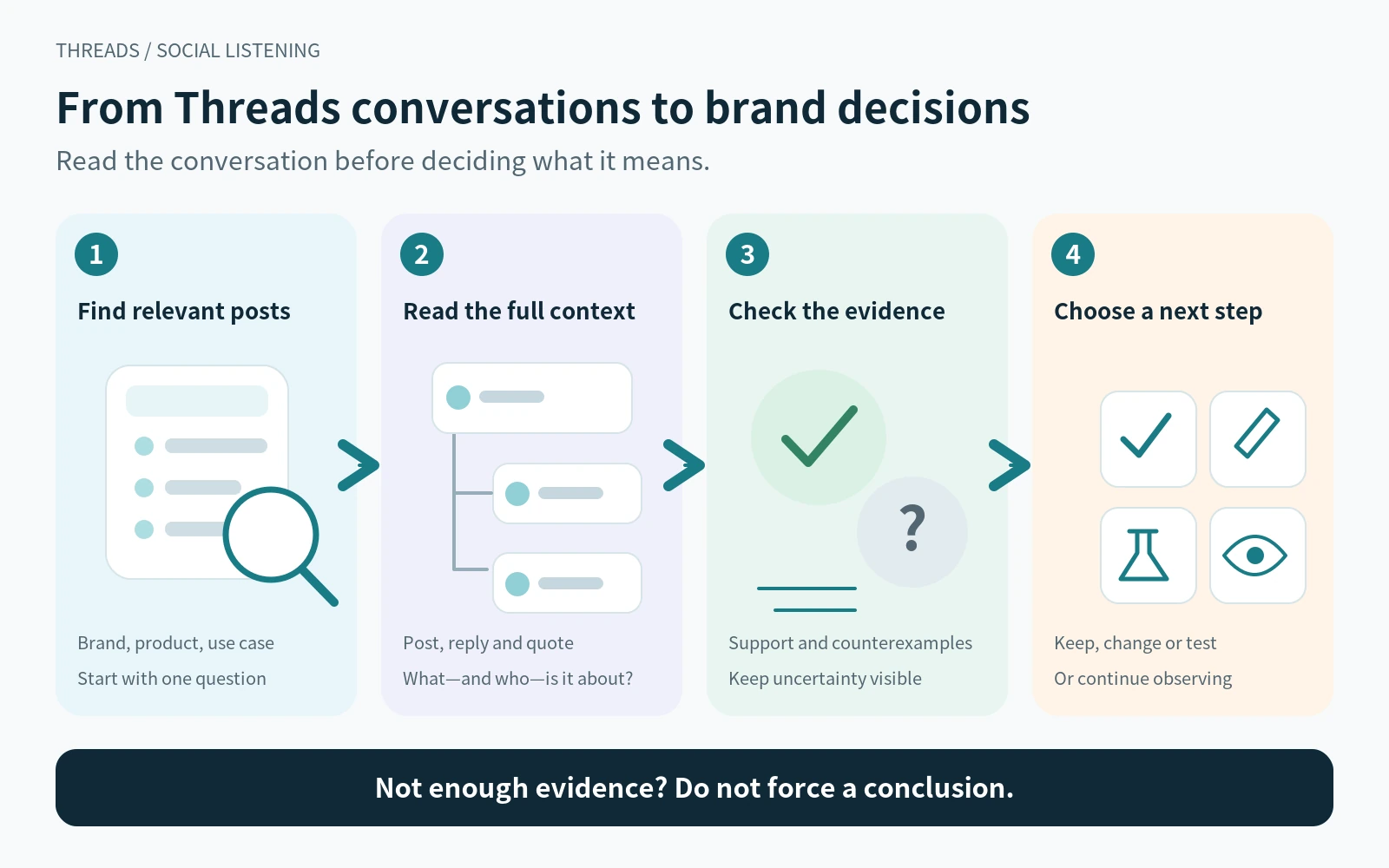
4. Anonymised cases and a teaching example: similar comments, different next steps
Cases one and three retain anonymised summaries from an existing ACS/UNDARIS retail research record. The underlying work covered Instagram and Threads; these examples use records identified as Threads with original-post context available. Cross-platform results are not presented as Threads-only findings. Example two is a separately created fictional teaching scenario, not part of that study.
Identifying brands, products, campaigns, dates and accounts have been omitted. The case descriptions summarise the meaning of recorded discussions; they are not verbatim quotations. They do not establish that the posts remain public or that user claims were independently verified against operational data. This public article demonstrates interpretation, not a reproducible public dataset.
Case one: questions about participation are not proof of an unpopular campaign
An original post showed a physical item from a retail promotion. Replies asked how to participate, while another pointed out that obtaining a particular variant involved a separate in-store purchase condition.
Research interpretation: the conversation concerns participation steps and eligibility. Some disappointed wording should not turn every process question into a generic negative mention.
This exchange alone cannot establish the campaign’s overall appeal or prove widespread confusion. A useful next step is to check whether the campaign page, creative and in-store information explain the condition clearly, then look for the same question in independent discussions.
Investigate a possible information gap before proposing a bigger discount. That is a direction to test, not a demonstrated need to change prices or rules.
Example two: attractive packaging, but a price that makes someone hesitate
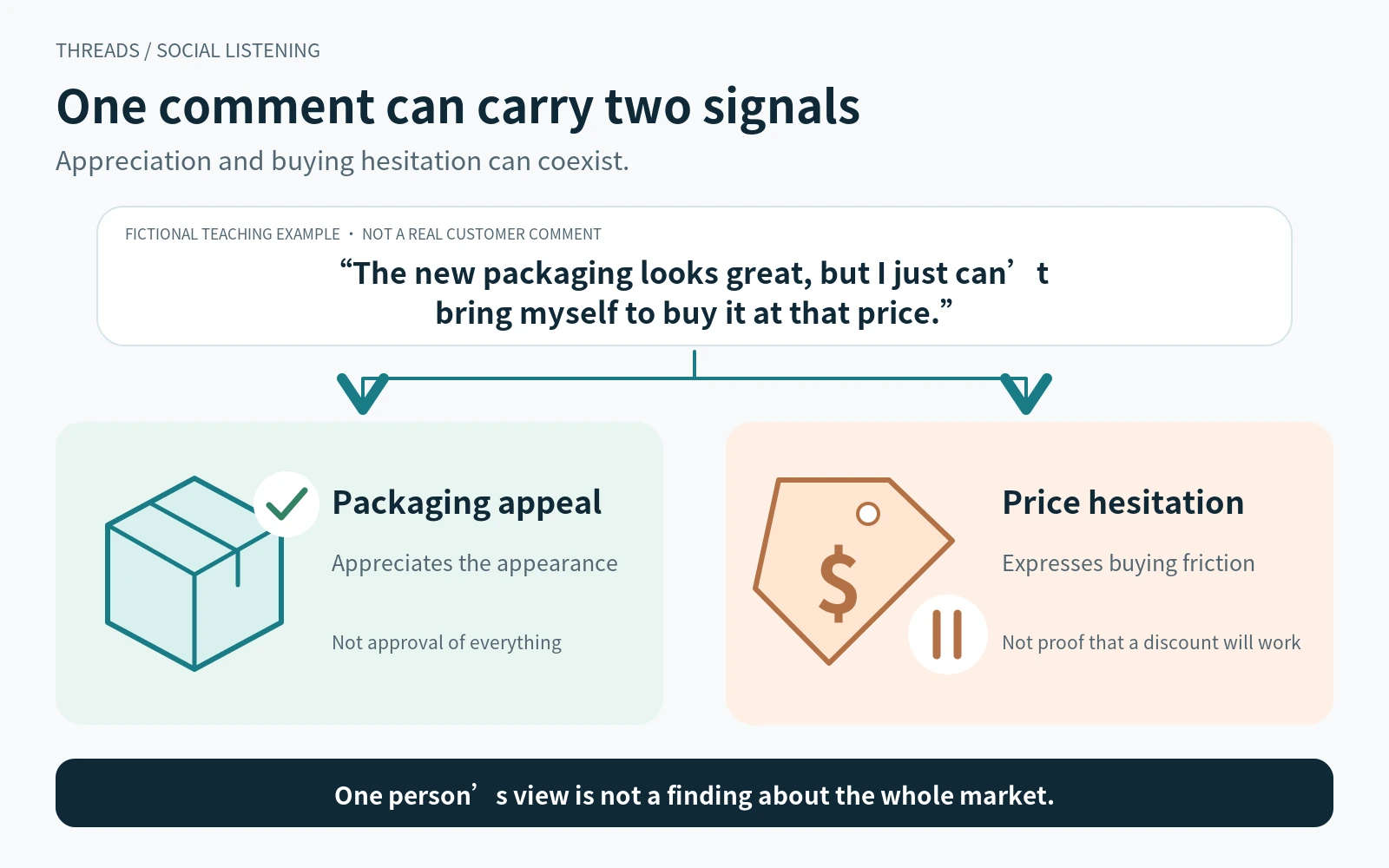
This is a fictional teaching example—not a client comment, a real Threads post or a research finding. Imagine a post introducing new packaging and a reply saying:
The new packaging looks great, but I just can’t bring myself to buy it at that price.
The Hong Kong Cantonese version is: 「個新包裝幾靚,但呢個價我真係買唔落手。」
There is no need to invent sarcasm or a hidden meaning. The sentence openly contains two judgements.
| What the comment addresses | Signal worth retaining | What it does not establish |
|---|---|---|
| “The new packaging looks great” | This person appreciates the appearance. | Most consumers like the packaging, or the product is successful overall. |
| “I can’t bring myself to buy it at that price” | This person expresses a price or value concern. | A discount will necessarily work, or everyone finds it unaffordable. |
A single negative label would erase the positive design response. A single positive label would miss the buying friction. Keep the target of the judgement, the attitude and the unanswered question separate.
The next step is not automatically a price cut. First check whether similar concerns recur independently and whether the product’s quantity, features, pricing and communication explain its value. Then consider testing a clearer value message or offer structure—or collecting more evidence.
Case three: disagreement in the replies should not inherit the original post’s sentiment
A third original post criticised a product experience. Some replies agreed, while another explicitly liked the taste that the original author disliked. Other comments discussed portion size, alternatives and purchasing convenience.
Research interpretation: the conversation contains different preferences and evaluation criteria. The original author’s position does not describe every participant.
Each reply needs its own target: which product or feature is being evaluated, and is the person describing an experience, making a comparison or responding to another participant?
A negative original post does not make every reply negative about the brand. A favourable reply does not make the original complaint irrelevant.
A next step could be to investigate the specific experience and design focused interviews or tests to distinguish preference differences, usage situations and consistency issues. This conversation alone does not establish that the whole range is defective—or that most customers are satisfied.
5. Let AI help organise the material, without forcing a judgement
The point is not to discover one “true emotion” in every sentence. It is to avoid manufacturing certainty to fill a report.
ACS recommends using AI for initial organisation and classification, with researchers reviewing discussions that materially affect the recommendations. Sarcasm, short replies, unclear comparison targets, missing context and claims about product or service risk deserve particular attention.
Keep the original post and relevant replies, the target of the discussion, supporting evidence, counterexamples and remaining unknowns for each main finding. When reply relationships are missing, disclose partial context instead of reconstructing an exchange that was never obtained.
For more detail on language interpretation and human review, see our Cantonese sentiment analysis validation guide.
Unconfirmed should remain unconfirmed. It is better than turning uncertainty into a precise-looking result.
6. What should a Threads social listening report deliver?
A useful report goes beyond keywords, popular posts and sentiment percentages. For ACS, it should explain what was found, how far the evidence supports it, what to do next and how to check whether that action helped.
The cases and teaching example above suggest testable directions, not implemented client outcomes:
| Finding or hypothesis | Possible next step | What to check afterwards |
|---|---|---|
| Questions about participation or eligibility | Review and test clearer instructions. | Similar enquiries, participation behaviour and customer-service feedback. |
| Packaging appeal alongside price concern—fictional example | Check value communication before testing messages or offer structures. | Independent discussion, understanding of value and actual conversion data. |
| Different product preferences and evaluation criteria | Separate the features being discussed and investigate or test them. | Whether interviews, product tests and observed feedback support the hypothesis. |
Not seeing another complaint does not prove resolution. Someone saying they are interested does not prove a sale. Where effectiveness matters, compare social discussion with appropriate service, operational or business data.
A study may recommend keeping, changing, testing or observing. Sometimes the useful conclusion is not to overhaul a strategy in response to one popular post.
Frequently asked questions
Can a brand with few mentions still research Threads?
Yes: start with the category, alternatives and relevant use situations. Label these as category findings rather than presenting general discussion or other brands’ experiences as conclusions about your own brand.
Can Threads social listening replace a survey?
Not as a direct substitute. In this research approach, public conversation helps identify questions, interpret context and form hypotheses. It is not a representative sample of the target market. Estimating how many consumers hold a view requires an appropriate sampling and validation design.
Does an official API mean every Threads conversation can be monitored?
No. Public search, access to replies and a vendor’s integration are different checks. Ask about the time window, permissions, reply coverage and missing data rather than treating platform support as comprehensive access.1
Can a sentiment score prove that a campaign succeeded?
Not from these examples. A comment can praise the packaging while questioning the price, or express interest without a purchase. Evaluate the campaign against its defined objectives and corresponding outcome data, not just a sentiment score.
Start with a brand question, not a demand for a bigger dataset
Before commissioning a study, define the decision, the period to examine and the relevant product, campaign or conversation material already available.
People are discussing your brand on Threads, but the team is unsure what to follow up? Bring ACS a specific question and the relevant discussions. We can establish what the available evidence can answer and whether UNDARIS social listening research is a suitable next step.
Explore UNDARIS social listening research.
Threads may not hand you the answer. A carefully interpreted conversation can help you ask the right next question.
Source and case note: Platform claims use the official sources below, checked on 7 September 2026. Features and permissions can change. Cases one and three are inherited anonymised research summaries; example two and the illustrated comments are fictional teaching material. No confidential client report, original quotation or identifying information is published. This article is not a cross-tool accuracy benchmark and does not claim verified sales improvements.
Footnotes
-
Meta’s official Postman workspace, Discover Threads. Describes public post search, not unrestricted historical or reply coverage. ↩ ↩2 ↩3
-
Brandwatch, Threads data network. ↩
-
Meta, New Threads Features for a More Personalized Experience That You Control, including reply-approval and follower-only-reply updates. ↩
EVIDENCE LINKS
Sources and further reading
When an article uses current events or external information, the actual sources are listed here.