
Media
Meta & Google Ads Trends 2026: Why Creative Matters More Than Audience Targeting
Explore how Meta and Google use creative in AI ad matching, why brands need distinct ideas to test, and where AI can reduce repeat production work.
Author: AI Concept Studio
When platforms do more of the audience matching, where should brands invest their effort next?
“Is the audience targeting wrong?”
When a Facebook, Instagram or Google campaign underperforms, targeting is an obvious place to start. Are the interests right? Should the audience be narrower? Is an important keyword missing?
Those questions still matter. But as platforms automate more matching decisions, another question deserves attention: if campaign settings are no longer the only differentiator, how many genuinely useful creative ideas are we giving the platform to work with?
Meta’s recommendation models learn from creative features. Google AI Max also uses ad content and URLs to identify relevant searches. Creative is not simply what appears after a match has been made. It is also an input into how systems understand an ad and assess its relevance.123
“More important” is not a universal ranking of factors across every advertising account. It is a strategic argument: rather than concentrating all their effort on manually constructing audiences, brands should invest seriously in creative angles, messaging and ongoing testing.
The difficulty is that more creative demand does not automatically come with more budget or people. This is where AI-assisted creative production becomes useful: reducing suitable repeatable work so that more worthwhile ideas can actually be produced and tested.
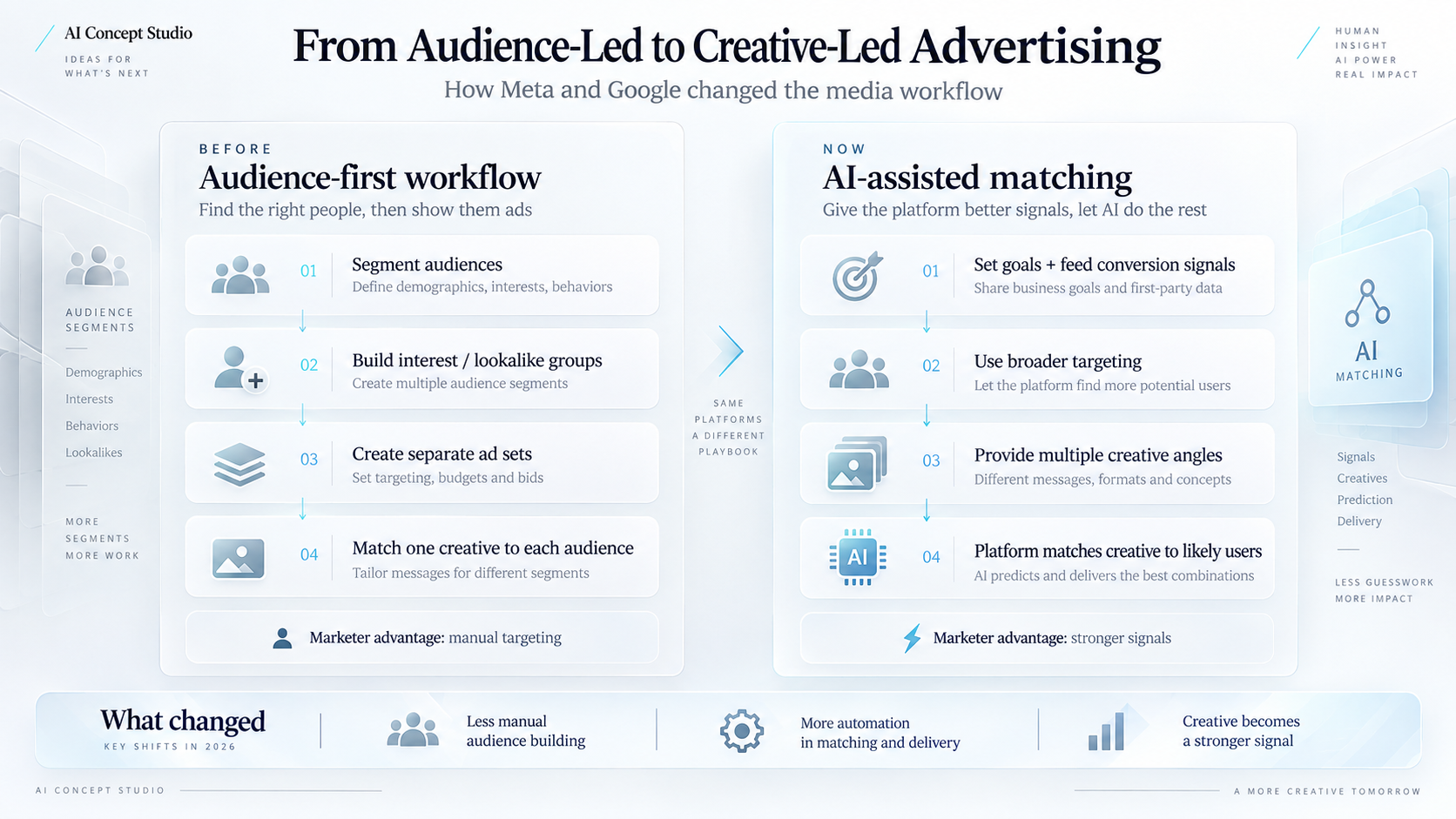
1. From building audiences to deciding what signals to provide
Consider a simplified campaign workflow. On Meta, a team might first divide people by age, interests, lookalikes and retargeting groups, create separate ad sets, then assign images and copy. On Google Search, the starting point might be keyword groups, match types and ad group structure.
This is an illustration, not a claim that platforms previously operated without AI or that creative used to be unimportant. Meta was already describing AI’s longstanding role in advertising in 2023, alongside Advantage+ automation of campaign setup, creative and placements.4
The change is not from “no AI” to “AI”. It is a change in which decisions the advertiser makes and which the platform handles.
The old planning question was often: “Which group should we select, and what should we show them?” With more automated matching, ACS sees a stronger starting point: What is the business objective? What counts as a valuable conversion? Which customer needs could the product address? What restrictions must remain in place?
The work does not become less strategic. More of the strategy moves from additional settings to better inputs.
2. Meta: Advantage+, Andromeda and GEM do different jobs
These names describe different parts of Meta’s advertising system, rather than three interchangeable AI features.
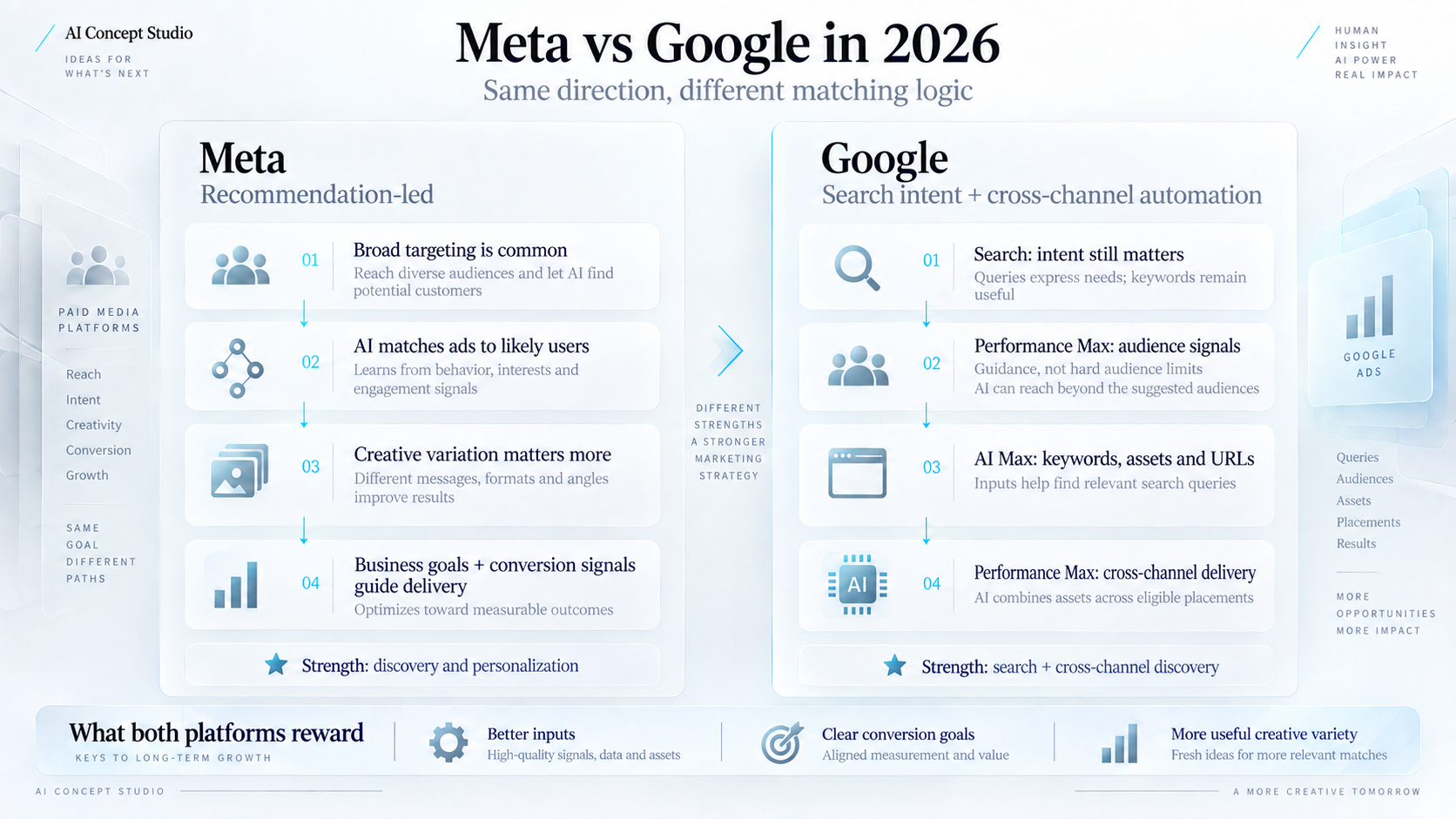
Advantage+ is the advertiser-facing automation suite. Meta’s Andromeda engineering article describes automation across audience creation, budget allocation, placements and creative generation.5
Andromeda handles ad retrieval. It selects relevant candidates early in the recommendation process for subsequent ranking. Meta identifies the growth in eligible creative, supported by Advantage+ and generative AI, as a challenge the system is designed to address.5
GEM is a foundation model supporting ad recommendations. Meta’s November 2025 technical article describes learning from ad content, user interactions and features including ad format, location and “creative representation”. Its August 2026 engineering update again identifies ad creative features alongside user activity data.12
In practical terms, a creative representation is information a model can use to learn about an ad’s characteristics. The ad is not just an image waiting to be displayed. Its content is also something the recommendation system learns from.
That does not mean Meta looks at one picture and immediately knows exactly who should buy. Behaviour, objectives, measurement signals and other information also contribute. Nor is GEM a design tool that directly generates campaign artwork.12
The useful takeaway for brands is not the terminology. It is a question: when the platform can handle more matching, are we providing clear, genuinely different messages for it to work with?
3. Google is changing too, but Search and Performance Max are not the same
Saying that Meta and Google both “look at the image and find an audience” misses important differences between advertising products.
Performance Max: audience signals are guidance, not a fence
Performance Max operates across channels including Search, YouTube and Display. Google defines its audience signals as optional suggestions that guide AI. PMax can also reach people outside those signals when they are considered likely to convert.67
Providing an audience signal is therefore not the same as restricting delivery to that audience.
The same documentation lists website visitors and customer lists among useful first-party inputs. Not having to predefine every potential customer does not make customer knowledge irrelevant.6
AI Max for Search: ad content contributes to search matching
Google introduced AI Max for Search in 2025. It learns from existing keywords, creative assets and URLs, using broad match and keywordless matching to identify relevant searches. Its features can also adapt text and select relevant destination pages.38
Here, creative should not be understood only as images and video. Search ad copy, product messaging and website content matter too.
Search still revolves around the needs people express through their searches. AI Max expands matching; it does not make intent, keywords or landing pages irrelevant. Google also retains brand, location and URL-related controls.38
A three-part comparison is more useful than treating all Google advertising as one system:
| Advertising environment | What is changing? | What must the brand still provide? |
|---|---|---|
| Meta recommendation environments, including Feed and Reels | More platform-led discovery, retrieval and personalised matching | Creative, objectives, usable data and delivery constraints |
| Google Search / AI Max | Expanded search matching informed by ads and website content | Relevant messaging, keywords, website content and controls |
| Google Performance Max | Cross-channel matching, with audience signals providing guidance rather than a fixed boundary | Varied assets, customer data, conversion goals and suitable destinations |
For brands, these environments call for different preparation: clear creative angles on Meta; connected search intent, messaging and website content in Search; and cross-channel assets and conversion signals in PMax. Account settings should reflect the product, objective and circumstances.52637
If you use Google Search, your AI Max transition timeline depends on your existing settings. Google announced AI Max’s move out of beta in April 2026. Under its June update, automatic upgrades for ACA and the campaign-level broad match setting begin in September 2026, while Dynamic Search Ads auto-upgrades begin in February 2027. Brands can check which features their accounts use and plan the relevant adjustments.8
4. One product can support several creative hypotheses
Imagine a brand selling an ergonomic chair.
One approach is to build three audience groups and give each the same product photograph with a different caption. Another is to start with three different reasons someone might consider the product, then turn those reasons into distinct ads.
| Creative angle | Visual and message direction | What would the test investigate? |
|---|---|---|
| Long working hours | Show everyday desk use and demonstrate verified adjustment features | Does explaining how the chair is used generate more enquiries than a standalone product image? |
| Working from home | Place the chair in a believable home workspace | Does a domestic setting help people picture the product in their own lives? |
| Interior design | Focus on appearance, materials and how the chair fits a room | Is visual style a separate motivation worth exploring? |
This is an illustrative ACS framework, not a client case study or a medical benefit claim.
Three angles do not automatically create three separate audiences. The same person may care about comfort, home working and design.
The important shift is that the brand is expressing reasons to buy, rather than describing customers only through demographic or interest labels. Those messages become testable content. The platform combines them with other signals, and results are still needed to determine what works.13
Creative is not another word for audience. It is how a brand expresses different needs, uses and purchase motivations.
5. The useful increase is not simply in file count
In January 2026, Google’s official advertising strategy article stated:
“Creative is now the primary lever for success.”9
Google has also explained that asset variety supports more relevant placements and gives campaigns more options for different customer needs. That is clear guidance to invest in creative, not proof that each additional image causes an additional sale.10
ACS recommends separating two types of variation.
Format adaptation makes an idea usable across placements: square, portrait and vertical assets, with suitable composition, captions and safe areas. This work matters, but primarily answers: “Will this creative work in this space?”
Creative hypotheses change the motivation, opening, evidence or story. They ask: “What could we communicate differently to encourage understanding or action?”
Ten sizes of the same artwork are not ten ideas. Equally, a caption change is not necessarily superficial. Changing the central proposition can create a genuinely different test.
For example, three angles, two openings and two formats create 12 production options. That is a planning example, not a platform requirement or an instruction to launch all 12 at once. Budget, available data and review capacity should determine the scope.
The objective is not maximum output. Each version should answer two questions: What is different, and what do we hope to learn?
6. Greater creative importance changes the resource question
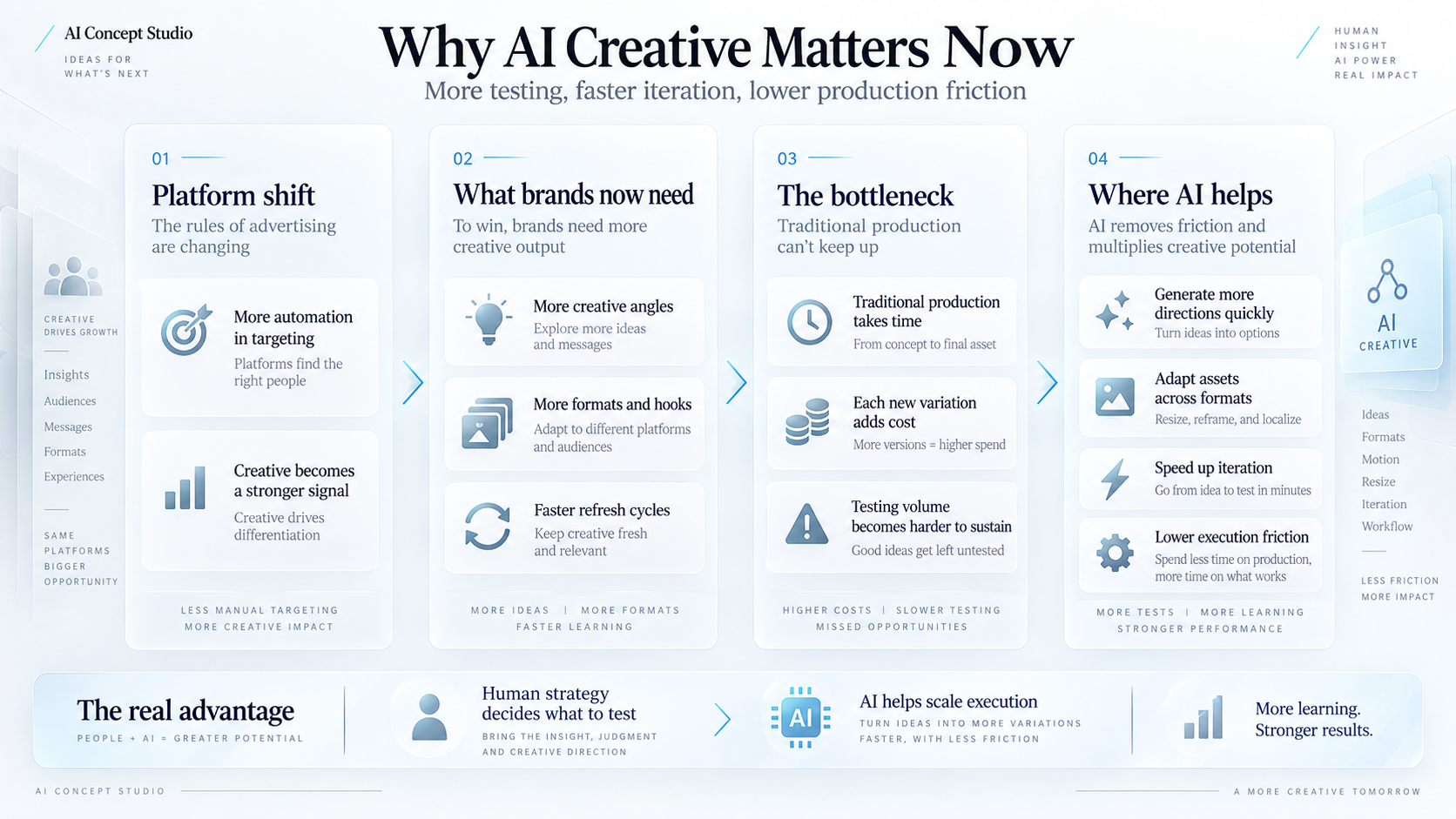
Testing more angles adds work beyond design.
A new direction may require another opening, product demonstration, storyboard, setting, edit, format adaptation and approval. When every version starts from scratch, worthwhile ideas can remain untested because the team lacks time or capacity.
Google acknowledged this pressure when introducing generative assets for PMax in 2023: advertisers had identified creating and scaling assets as one of the hardest parts of cross-channel campaigns.7
The business implication is that greater creative demand makes production capacity another constraint to manage. This does not make conventional production obsolete. It means a one-off major production and an ongoing programme of creative tests may need different cost structures.
A brand should therefore ask more than “What does this production cost?” Can the workflow support another round? Can approved product assets be reused? Does changing one opening require rebuilding the entire video?
For a resource-constrained team, the most useful response may not be a larger total budget. It may be less repeat work, leaving more capacity for new ideas and learning.
7. AI’s opportunity is a lower production barrier for each creative test
This is the commercial case for AI-assisted creative production.
The argument is not that brands should use AI simply because it can generate an image. It is that AI can support suitable production, adaptation and revision tasks, giving a team more room to explore worthwhile ideas.
The platforms’ own tools reflect that need.
Meta’s 2023 AI Sandbox announcement included experiments in text variation, background generation and image outcropping. Google’s 2025 Asset Studio announcement covered lifestyle imagery, style references, batch image work and video assets.114
In May 2026, Google described Asset Studio generating different themes and asset types from a marketing brief, brand guidelines, a website and goals, with natural-language refinement and asset A/B testing. The announcement specified a global English-language rollout that summer; it did not establish support for every Hong Kong Traditional Chinese workflow or availability in every account.12
At ACS, the useful question is whether this changes the cost of producing a usable version—not how many images a tool can output.
One internal evaluation approach is:
Production cost per usable test version ≈ total planning, tool, production, revision and approval costs ÷ the number of quality-approved versions ready to run.
This is an ACS evaluation framework, not an official platform metric.
AI may shorten execution, but outputs still need selection, correction and review. A cheaper tool does not automatically make the whole project cheaper. Generating 100 images and approving only two is not necessarily efficient.
The official material cited here does not provide a universal production-cost saving percentage. The reasonable opportunity is conditional: when AI reduces repeatable execution without introducing excessive correction and review, a brand may explore more ideas with similar resources.
Production savings must also be kept separate from media performance. Lower production cost does not automatically mean lower acquisition cost, lower ad spend or higher ROAS. Those outcomes still require campaign evidence.
8. People set the direction; AI supports production
AI can help with execution and concept exploration, but a team remains accountable for the final message and asset.
Google’s generative asset workflow retains advertiser review and selection. Asset Studio also emphasises style references, previews and approvals. Generated is not the same as ready to publish.711
ACS recommends retaining three decisions.
Is it worth making? What communication problem does the idea address? What supports the angle? Does it express a real product advantage, or simply produce an attractive image?
Is it suitable to use? Are the product, packaging, text and usage accurate? Are claims supported and usage rights clear? A generated character should not be presented as a real customer testimonial.
What should happen next? More clicks do not necessarily mean more valuable enquiries. More conversions need to be assessed against their quality and the business objective. Google provides asset-level conversion reporting in PMax, but observed differences should inform hypotheses—not automatically be treated as effects caused by the creative alone.10
Our view of the division of work is straightforward:
AI helps reduce repeat production. People decide which ideas deserve to be made, tested and developed further.
9. Where should a Hong Kong brand start?
There is no need to dismantle every existing campaign or adopt a target of generating 100 images a month.
ACS recommends starting with one product, one primary business objective and a usable way to assess results. Confirm the objective, tracking and necessary restrictions before deciding what creative to test.
For example, counting clicks into an enquiry form cannot establish whether creative has produced more valuable business enquiries. Define how a suitable enquiry will be identified and checked before comparing versions.
Then develop a small number of genuinely different angles. For each, define the need being addressed, the message, the supporting evidence and the intended action. Produce a representative version before extending it into more formats.
Finally, connect production with campaign learning. Google recommends using asset reporting to examine conversion volume and value and improve the mix. ACS also recommends recording production time, revision effort and enquiry quality, so the team can distinguish a messaging problem from a production problem.10
Build a cycle of hypothesis, production, testing, learning and iteration—not just a larger asset folder.
Frequently asked questions
Does greater creative importance mean audience targeting is no longer necessary?
No. Meta’s recommendation models combine creative features with user activity and engagement data; they do not find customers from an image alone. For brands, understanding customer needs remains a foundation for messaging and creative planning.12
Google PMax audience signals provide guidance rather than a fixed delivery boundary, but customer data remains useful. AI Max also retains controls. Across Meta and Google, the shift concerns where teams focus their effort, not the removal of customer understanding, data or necessary restrictions.68
Does Google Search no longer need keywords?
No. AI Max learns from existing keywords, ad content and URLs to expand matching. It changes how campaigns identify relevant searches; it does not remove the importance of relevance or search intent.3
Is AI-generated advertising always cheaper and more effective?
No. Include generation, revision, checking and approval when evaluating cost. More efficient production does not guarantee better conversions. The opportunity discussed here is to reduce suitable repeatable work, not to promise an advertising result.
Creative is part of media strategy
It is easy to place creative at the end of a media plan: decide who should see the ad, then arrange production.
When ad content contributes to matching, that sequence deserves reconsideration. The product angle, supporting evidence, opening and intended audience understanding should be discussed as part of strategy—not left until execution.
ACS’s view is that as platforms take on more matching decisions, brands should invest more deliberately in distinct creative and the capacity to keep learning.
AI’s breakthrough is not replacing creativity. It is reducing repeatable production so a finite budget can support more ideas worth testing.
That is the starting point for ACS Digital Creative. People lead the message, angle and visual direction. AI supports suitable exploration, asset extensions and version work, followed by human checks against product and brand requirements. Meta images and short videos, and Google or YouTube assets, are scoped around the campaign—not produced merely to increase the count.
Your brand has products and selling points, but production cannot keep up with the angles you want to test? Start with one product, one campaign and the assets already available. Identify what deserves to be preserved and which repeatable work can be reduced.
Explore ACS Digital Creative: Creative Strategy, Advertising Images and Video Production
Save on repeat work. Not on creativity.
Source and scope note: This article draws on official Meta and Google engineering articles, product announcements and help documentation, with information checked to 16 September 2026. Announcement dates do not establish availability in every account; features vary by market, language, account and rollout. The chair example, version combinations and cost framework are ACS illustrations or strategic analysis—not client results, platform minimums or guarantees of performance or cost savings.
Official references
Footnotes
-
Meta Engineering, Meta’s Generative Ads Model (GEM): The Central Brain Accelerating Ads Recommendation AI Innovation, 10 November 2025. Official article. ↩ ↩2 ↩3 ↩4 ↩5
-
Meta Engineering, GEM Training: How Meta Doubled the Efficiency of Its LLM-Scale Ads Foundation Model, 3 August 2026. Official article. ↩ ↩2 ↩3 ↩4 ↩5
-
Google Ads & Commerce Blog, Unlock next-level performance with AI Max for Search campaigns, 6 May 2025. Official article. ↩ ↩2 ↩3 ↩4 ↩5 ↩6
-
Meta Newsroom, How AI is Powering Marketing Success and Business Growth, 20 June 2023. Official article. ↩ ↩2
-
Meta Engineering, Meta Andromeda: Supercharging Advantage+ automation with the next-gen personalized ads retrieval engine, 2 December 2024. Official article. ↩ ↩2 ↩3
-
Google Ads Help, About audience signals for Performance Max campaigns, no publication date displayed. Official documentation. ↩ ↩2 ↩3 ↩4
-
Google Ads & Commerce Blog, Get creative with generative AI in Performance Max, 7 November 2023. Official article. ↩ ↩2 ↩3 ↩4
-
Google Ads & Commerce Blog, We’re upgrading Dynamic Search Ads to AI Max, 15 April 2026; migration schedule updated 11 June 2026. This article follows the revised schedule. Official article. ↩ ↩2 ↩3 ↩4
-
Google Ads & Commerce Blog, Ads Decoded presents three AI strategies to master the future of marketing in 2026, 28 January 2026. Official article. ↩
-
Google Ads & Commerce Blog, New reporting and genAI tools to boost creative results, 30 July 2024. Official article. ↩ ↩2 ↩3
-
Google Ads & Commerce Blog, Generate and scale creative assets with Google AI in Asset Studio, 10 September 2025. Official article. ↩ ↩2
-
Google Ads & Commerce Blog, Asset Studio is entering a new era of AI-powered creativity, 20 May 2026. Official article. ↩
EVIDENCE LINKS
Sources and further reading
When an article uses current events or external information, the actual sources are listed here.
- 01Meta Andromeda: Supercharging Advantage+ automation with the next-gen personalized ads retrieval engine
- 02Meta’s Generative Ads Model (GEM): The Central Brain Accelerating Ads Recommendation AI Innovation
- 03GEM Training: How Meta Doubled the Efficiency of Its LLM-Scale Ads Foundation Model
- 04About audience signals for Performance Max campaigns
- 05Unlock next-level performance with AI Max for Search campaigns
- 06We’re upgrading Dynamic Search Ads to AI Max
- 07Ads Decoded presents three AI strategies to master the future of marketing in 2026
- 08New reporting and genAI tools to boost creative results
- 09Get creative with generative AI in Performance Max
- 10Generate and scale creative assets with Google AI in Asset Studio
- 11Asset Studio is entering a new era of AI-powered creativity
- 12How AI is Powering Marketing Success and Business Growth